
Wuppertal Institute and Tsinghua University Strengthen Research Cooperation
Memorandum of Understanding signed with China’s leading technical-scientific university
Memorandum of Understanding signed with China’s leading technical-scientific university
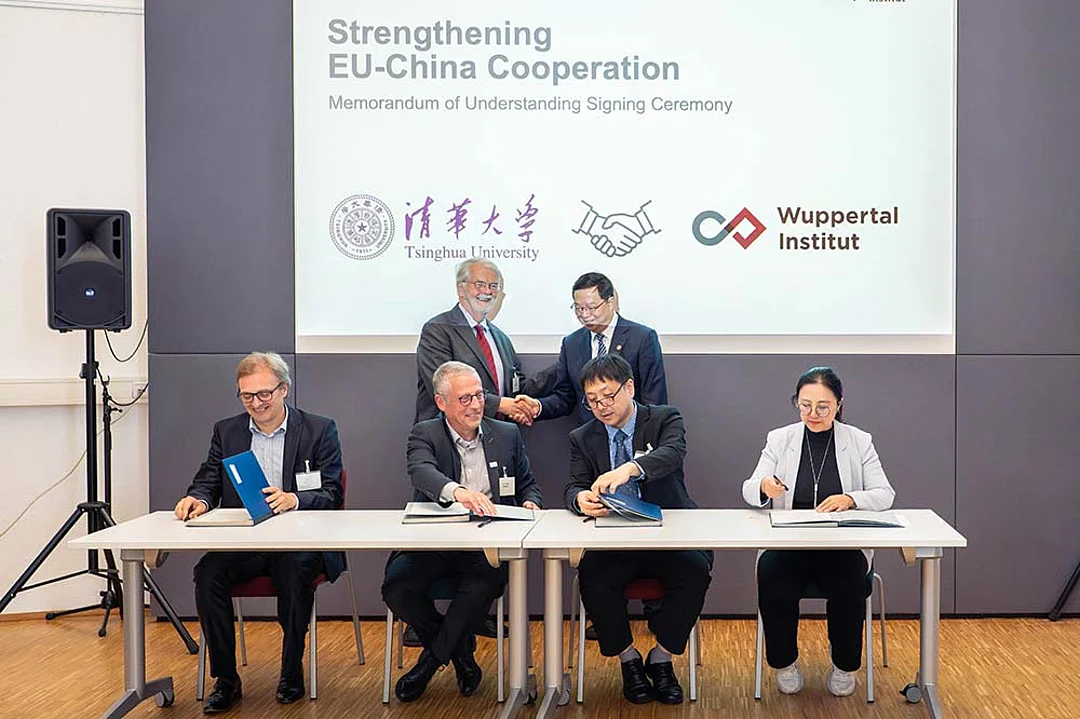
In what ways can Europe and China cooperate to tackle climate change and global transformation challenges? This is the question the Wuppertal Institute and Tsinghua University have been exploring as part of their longstanding scientific cooperation. By signing a Memorandum of Understanding (MoU) on 2 September in Wuppertal, the two institutions have strengthened their collaboration, establishing a solid framework for further joint research activities.
"International scientific cooperation is becoming increasingly important, particularly in the face of growing geopolitical tensions: joint research helps bring together different perspectives and makes knowledge available to address global challenges," says Dr. Lukas Hermwille, Co-Head of the Transformative Industrial Policy Research Unit at the Wuppertal Institute.
Joint research focus: energy transition and decarbonisation of energy-intensive industries
For many years, Tsinghua University and the Wuppertal Institute have made important contributions to high-quality, practice-oriented research, with their expertise complementing each other perfectly: both institutions, for example, have dedicated research units addressing the diverse challenges associated with coal phase-out, making important contributions to scientific and policy debates on a sustainable and just transition.
An important starting point for deepening the cooperation is the "EU-China Bridge" project, an international research initiative aimed at advancing the decarbonisation of energy-intensive industries in Europe and China. The project is part of an EU-China Flagship Initiative on climate action and biodiversity. The Wuppertal Institute coordinates the European component and consortium, while Tsinghua University assumes the corresponding role on the Chinese side.
Prof. Guan Dabo, Deputy Dean of the Institute for Carbon Neutrality at Tsinghua University, plays a central role in the cooperation formalised by the MoU. Together with Dr. Lukas Hermwille, he presented the key areas of the EU-China Flagship Initiative as part of the academic exchange and discussed prospects for further cooperation.
Prof. Qiu Yong, Secretary of the CPC Tsinghua University Committee and Chairperson of the University Council, also emphasised the importance of the cooperation from Tsinghua University’s perspective. The MoU was subsequently signed by representatives of both institutions: on behalf of the Wuppertal Institute, by Michael Dedek, Administrative Managing Director, and Henning Wilts, Member of the Institute’s Management Team and Head of Transfer and Impact. Tsinghua University was represented by Prof. Guan Dabo and Xiao Qian, Director of the Office of International Cooperation and Exchange.
Following the signing ceremony, the focus shifted to scientific exchange: Researchers from Tsinghua University and the Wuppertal Institute discussed issues related to energy and industrial transformation, including technological transformation pathways, scientific research questions and policy options.
By signing the Memorandum of Understanding, the Wuppertal Institute and Tsinghua University reaffirm their commitment to expanding their scientific cooperation over the long term. At a time when joint responses to climate change and the challenges associated with the transformation of energy and industrial systems are more urgent than ever, the cooperation is intended to contribute to developing solutions for a sustainable future together.