
How Data Infrastructures Are Becoming a Key Resource for a Functioning Circular Economy
Circular Economy Information Ecosystem: prerequisite for success and driver of innovation for the digital circular economy

Circular Economy Information Ecosystem: prerequisite for success and driver of innovation for the digital circular economy
The ability to use, repair and recycle products for longer depends on one thing above all else: reliable data. A new In Brief from the Wuppertal Institute explains why digitisation is crucial for a functioning circular economy and which role the Circular Economy Information Ecosystem (CEIS) plays within this context.
Wuppertal, 15 April 2026: The transition to a functioning circular economy is one of the key challenges of our time. We can only achieve our climate goals and reduce environmental damage by using resources efficiently and keeping them in circulation. At the same time, the transition to a circular economy is the appropriate response to the intensifying geopolitical tensions and growing dependence on raw materials, which are increasingly shaping the framework conditions for business and industry. Closed-loop systems help make supply chains more resilient. This transformation requires digitisation to succeed. For the circular economy to work in practice, companies, public authorities and other stakeholders must be able to exchange and use data more effectively in future.
In the In Brief titled "The Circular Economy Information Ecosystem: Prerequisite for Success and Driver of Innovation for the Digital Circular Economy", Prof. Dr.-Ing. Stephan Ramesohl and Dr. Holger Berg from the Digital Transformation Research Unit at the Wuppertal Institute outline the digital foundations necessary to achieve this.
"A functioning circular economy requires reliable data along the entire value chain. Circular processes can only truly be implemented and scaled once physical product flows and digital information are systematically brought together," emphasises Stephan Ramesohl. "The ability to exchange data is therefore a core competence for sustainable economic activity," adds Holger Berg.
Digitisation as key to the circular economy: CEIS provides the foundation
Digital technologies unlock new opportunities to use resources more efficiently and close material cycles. Production processes can be optimised and new business models can be developed through the application of artificial intelligence (AI) in industry. Digital solutions also contribute in the areas of waste management, logistics and recycling, helping to better capture, sort and reuse materials.
The Circular Economy Information Ecosystem (CEIS) is at the centre of this development. It describes the entirety of all digital technologies, infrastructures, processes and stakeholders necessary for a data-based circular economy – including the required standards, rules and coordination mechanisms.
New opportunities for business and policy
A functioning CEIS can not only advance the circular economy but also provide new impetus for business and public administration. Establishing this requires coordinated efforts over a period of years. It is crucial to make use of the existing momentum for innovation and continue to develop it with a specific aim in mind. Among other things, the focus is on:
- Developing and scaling practical applications along the entire value chain
- Establishing sector-specific data ecosystems
- Further developing standards and international coordination
- Enhancing skills in business and public administration
- Coordinating existing initiatives and pilot projects more effectively
CEIS should be organised in a decentralised way, enable sovereign and role-based data exchange, be based on interoperable formats (jointly agreed technical rules for seamless interaction) and operate in a technology-neutral manner, not tied to any individual platforms. Another important component is the Digital Product Passport (DPP), which is being introduced under the European Ecodesign for Sustainable Products Regulation. In future, the intention is for the DPP to provide information on materials, reparability and the environmental impact of products, thereby creating a central database for the circular economy.
Press Release
Wuppertal Institut für Klima, Umwelt, Energie gGmbH
Responsible for content: Prof. Dr.-Ing. Manfred Fischedick, President and Scientific Managing Director
Contact: Christin Hasken, Head of Communications
Tel: +49 202 2492-187
Email: pr@wupperinst.org
Printable pictures
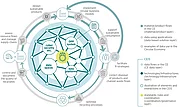
The Circular Economy Information Ecosystem (CEIS) forms the foundation of the digital circular economy. The diagram shows the CEIS at its centre, illustrating the interconnections between the various decentralised components for data exchange and data provision within the circular economy. Source: Wuppertal Institute
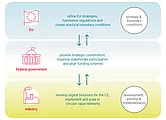
The successful implementation of the digital circular economy and the establishment of the CEIS require collaboration between the public and private sectors at all levels of decision-making. The federal government plays a key role in coordinating European framework conditions with national innovation support schemes and practical implementation through industry initiatives. Source: Wuppertal Institute