
Services
ServicesforBusiness
The Wuppertal Institute supports companies on the road to improved sustainability. Its researchers evaluate the attainment of environmental and social targets, develop future-ready concepts for business models and resilient supply chains, and support businesses in implementing and communicating measures.
Markets are evolving at rapid pace – so companies seeking long-term success must now rethink their approach. With this in mind, Wuppertal Institute researchers engage with key megatrends for business, examine the manifold challenges facing society and translate them into concrete operational strategy options and innovative business models. From analysing sustainability potential to developing proposals for optimising material cycles and introducing digital product passports, our researchers make sustainable transformations possible and secure competitive edges for the markets of tomorrow.
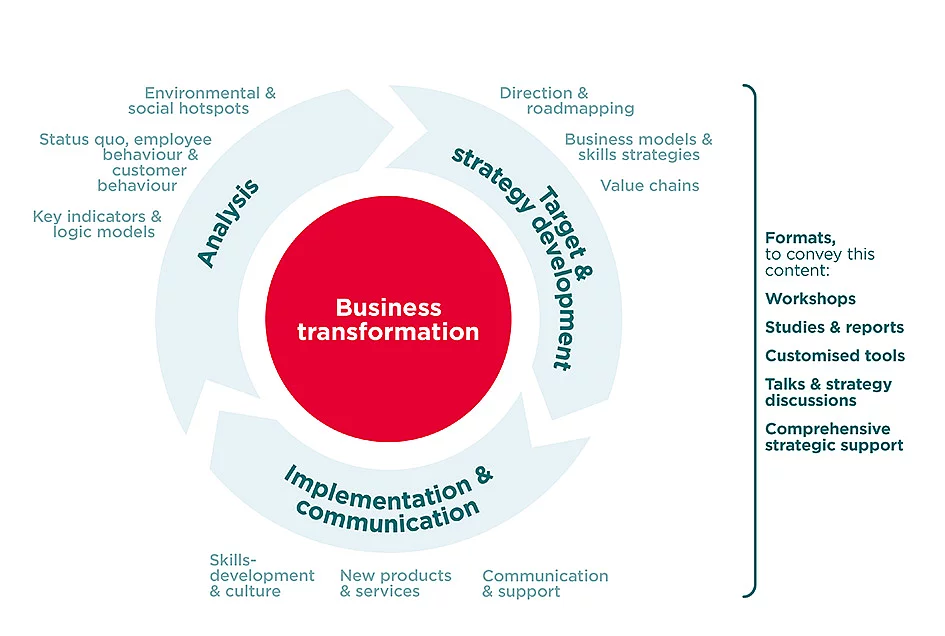
From scientific analysis to sustainable business practice
Companies that collaborate with the Wuppertal Institute benefit from our expertise in sustainability assessments, impact analyses and materiality analyses. Our researchers rely on recognised scientific methods characterised by a strong connection to practice. We seek to enable companies to apply the data and models we produce and continue developing them independently. Rather than simply gathering data, our researchers strive to deploy data to maximum strategic benefit for companies.
Our scientific service portfolio ranges from conducting forward-looking analyses to systematically mapping the benefits and drawbacks of planned measures through to measuring relevant parameters for sustainability reporting, including in line with the ESRS for the CSRD. In addition, our researchers develop customised tools that enable businesses to achieve their sustainability targets and conduct precise evaluations. The Wuppertal Institute supports companies with wide-ranging issues, including:
- Scientific support in transforming regulatory requirements to value for business and society
- Reviewing and assessing a company's proprietary tools/methods
- Implementing standardised procedures, including LCAs in line with ISO standards, carbon accounting as defined by the GHG Protocol and PCAF, and tailored analyses such as hotspot analyses
- Developing company-specific digital tools and calculation methods (e.g. for Product Carbon Footprints)
- Co-designing future-ready products and services
- Comprehensive scientific support in relation to trend analyses and future scenarios, impact mapping, identifying multiple impacts (of measures and products) and counter-factual scenarios
The Wuppertal Institute's long-running collaboration with GLS Bank is a prime example of what these analyses look like in practice. What started as a carbon footprint calculation project has evolved ever since. The Institute’s researchers have refined the underlying methodology to take account of the bank’s eco-friendly, socially sustainable financing strategy. In addition, both partners have contributed to conceptual development, including by publishing a thought leadership paper for political stakeholders on the topic of transformation finance. They have also explored key issues for the future – such as the risks of biodiversity loss for the financial sector – through joint research.
Developing and implementing targets and strategies
A strategy built on scientific insights paves the way for a company to shift to a sustainable business model and establish themselves effectively in the markets of tomorrow. Whether it's future-ready procurement management, optimised resource and material flows through circular products and services, or strategic use of digital passports to link production and consumption, the Wuppertal Institute’s researchers make transformation pathways quantifiable and achievable. Typical services in this area include:
- Generating insights that provide guidance in an increasingly complex world, based on a comprehensive radar approach (environmental, opportunity and strategy radar)
- Roadmapping: Identifying and minimising risks at an early stage, then systematically tapping into innovation potential
- Materiality analyses: Determining material sustainability topics on the basis of regulatory provisions and strategic utility, helping companies fulfil the reporting obligations set out in the Corporate Sustainability Reporting Directive (CSRD)
- Transition pathways: Developing precise, milestone-based pathways for the implementation of decarbonisation and transformation pathways
- Scenarios and vision development: Modelling alternative future scenarios and defining a clear, shared company vision, underpinned by (mega)trend analyses
- Business models: Developing innovative approaches that reconcile economic success and environmental viability – including eco-design and disruptive product-service systems
- (Brand) positioning and marketing strategies for future markets: Credibly and transparently embedding a genuine commitment to sustainability in the brand's DNA
- Change strategies and change management: Supporting cultural and structural change to secure internal buy-in for the transformation process
- Skills development: Fostering future-ready skills to support the active design of a sustainable transformation in the company
- Supply chains and value chains: Our researchers optimise company processes to maximise resilience and minimise resource consumption
- Resource strategy and security: Scientifically substantiated analyses to support targeted reductions in material, resource and energy consumption and the development of circular products, services and business models
Our research collaboration with BARMER, a health and long-term care insurance provider, is a prime example. With roughly nine million policyholders, BARMER is one of Germany's largest statutory health insurance providers. The overarching aim of the first joint undertaking was to integrate sustainability into the company’s business and brand strategy, with the project team making strategic and conceptual preparations and providing scientific support. Building on this, targeted studies were developed and implemented together with BARMER – such as the Exploratory "Climate Change and Health" Study and implementation projects including URBAN SusHealth.
Successful implementation, both internally and externally
Simply imposing strategies top-down is a likely way for companies to lose its employees motivationFuture viability is built on communicating analyses in a way that people can understand and implement; turning them into participants. This is precisely why the Wuppertal Institute's researchers don't just examine companies in isolation, looking on from the outside in. Instead, they support companies in communicating research outcomes and strategies in a way that generates motivation and fosters acceptance among the workforce.
However, an outward-facing perspective is just as important: if users, households and partners are engaged with changes from an early stage, it fosters trust in a company’s actions. But that’s not all: companies also gain direct insights into future market requirements and can develop tailored solutions in response – product-service systems, for example – that deliver meaningful added value.
Research services in this field comprise developing and implementing innovative, stakeholder-specific communication formats (both internal and external); developing and supporting learning spaces within the company; providing scientific support for internal training and skills development processes; and supporting change management, including through corresponding communication.
The long-standing collaboration between the Wuppertal Institute and Autostadt, an automotive visitor attraction in Wolfsburg, features a number of these services. The concept for the LEVEL GREEN exhibition, which opened in 2007, was created in the course of this partnership. The exhibition has evolved ever since, bringing scientific findings from sustainability research to life for a wide-ranging target audience – including families, business partners and people collecting cars from the nearby Volkswagen factory – and guiding sustainable lifestyle choices. It also provides insights into the implementation of sustainability in a business context, both at Autostadt and at Volkswagen.
The partnership has also given rise to further scientific studies and interventions, including an experiment on consumers’ willingness to pay for sustainably produced goods called "Pay What You Want", along with scientific support for the "GUT ESSEN" (EAT WELL) campaign.