
Real-World Labs: Spaces of CollaborativeExperimentation
Real-World labs enable researchers, companies, municipal administrations and citizens to trial how sustainable transformations can be achieved in practice. By collaborating across disciplinary boundaries and conducting experiments under everyday conditions, real-world lab participants work together to shape the future together.
From the climate crisis and digitalisation to biodiversity loss, the challenges facing society are becoming increasingly complex and call for new forms of collaboration between science and practice. So, while research continues to focus on societal developments, it is also increasingly conducted in partnership with the people and stakeholders shaping such changes. Real-world labs provide a highly conducive and collaborative framework for such research.
Real-world labs serve as spaces for experimentation, allowing participants from the field of practice – such as municipal administrations, companies and initiatives driven by civil society – to develop ideas together with researchers and test them in experiments under real-life conditions. Real-world labs tackle specific societal challenges jointly identified by all participants, meaning that even the research questions are formulated in a participative manner. The objective of real-world labs is to initiate and firmly establish sustainable transformations. This relies not only on a solid understanding of the baseline system but, above all, on knowledge of the desired outcomes and how that transformation could be achieved.
Real-world labs typically move through three phases:
- Co-design: Establishing a shared understanding of the problem and generating ideas
- Co-production: Conducting and monitoring real-world experiments
- Co-evaluation: Reflecting on the results and transferring them into science and practice
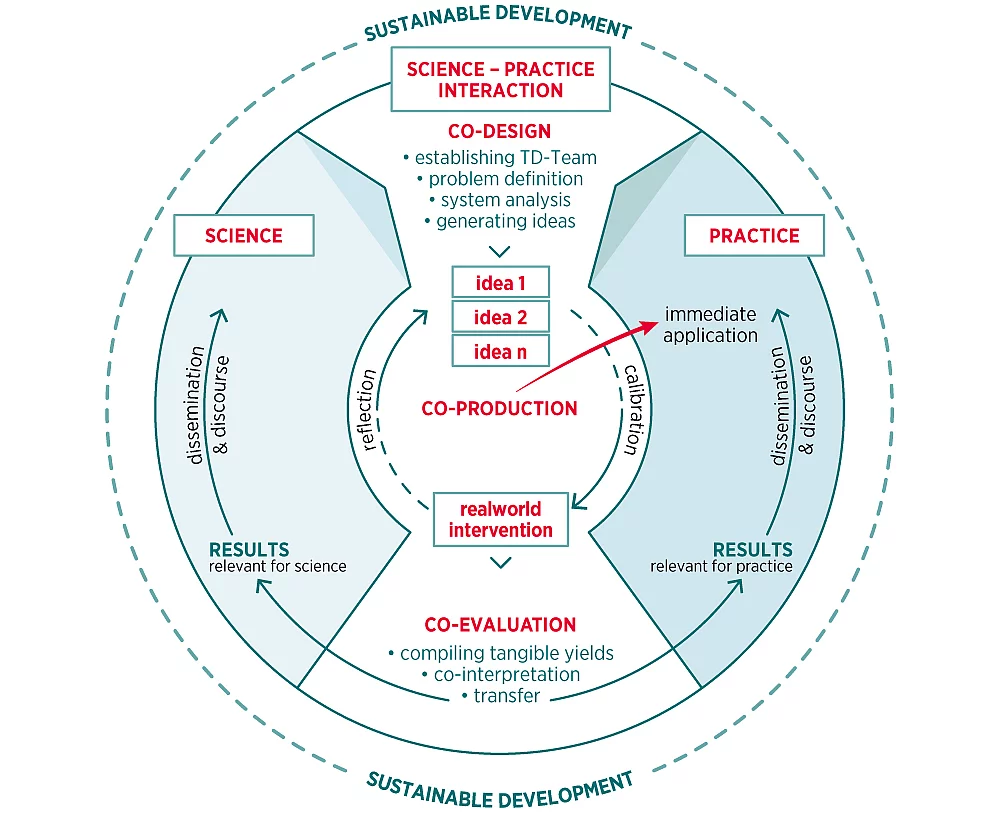
Potential impacts of real-world labs
The intention behind real-world laboratories is not only to generate new knowledge, but also to drive tangible change - such as new forms of collaboration between science, public administration, business and civil society; changes in decision-making processes within urban neighbourhoods; and more sustainable practices at the local level. For these impacts to become visible and understandable, the Wuppertal Institute deploys an impact model as standard practice, starting at the project design phase and integrates it systematically in the realisation of real-world labs projects.
Bridging experimentation, participation and societal transformation
The innovation of real-world labs lies in generating context-specific, problem-oriented, and participatory knowledge for sustainable transformation. Similar to traditional laboratories, real-world labs also focus on structured experimentation. The core method involves testing sustainable practices and models. Researchers and practitioners work together to engage in processes of innovation and transformation. In methodological terms, real-world labs build on established approaches, such as action and intervention research, and represent a methodological evolution in transdisciplinary research.
Real-world labs have been established in a wide variety of fields to test ideas directly in everyday life. In urban development, for example, real-world labs can be used to trial social concepts such as housing swaps. Real-world labs can transform empty retail premises into clothing exchanges to promote sustainable consumption, or turn unused spaces into small parks to support urban health.
Real-world lab research is understood as transformative science in the service of sustainable development. It goes beyond mere observation and pursues an explicitly creative and transformative agenda in the spirit of "science for society". Although this concept continues to evolve in academic discourse, this shared understanding forms the foundation of modern real-world lab research.
Wuppertal Institute paves the way for real-world lab research
The Wuppertal Institute has initiated real-world lab concepts since 2013. The Institute has developed core definitions, quality criteria and success factors, thereby contributing significantly to the scientific establishment of the approach. As a founding member of the "Real-World Labs for Sustainability" (Reallabore der Nachhaltigkeit) network, the Institute also plays a decisive role in shaping scientific networking and the development of common quality standards.
Interest in real-world labs has grown continuously in recent years. This is reflected both in the funding awarded by government ministries and in the establishment of networks such as "Real-World Labs for Sustainability" network, which now has over 200 members across the German-speaking world. The launch of the German Regulatory Sandboxes Innovation Portal (Reallabore-Innovationsportal) and the adoption of the German Federal Testing Act (Bundeserprobungsgesetz) have also fuelled their political significance.
The Wuppertal Institute contributes its scientific expertise to these developments and supports the growth of real-world labs as an instrument for driving sustainable transformation. In line with the increased importance of real-world labs in practical application, there is no conclusive definition of the real-world lab approach. Instead, the Wuppertal Institute pursues an open-ended approach in its real-world lab projects, in contrast with real-world labs designed to test pre-determinded solution options.
Projects
Here you find select sample rojects in the field of real-world laboratory research.