
Researchfor theTransformation
The Wuppertal Institute researches and develops target visions, strategies and practical tools to support transitions to a sustainable future at local, regional, national and international levels. This research centres around the search for solutions to the pressing environmental, societal, political and economic challenges of our times.
The Wuppertal Institute provides scientific insights that empower and enable stakeholders to design a more sustainable future. Rather than sticking to mere theory, the Institute translates its research findings into concrete orientation knowledge for practitioners. This orientation knowledge is formed by three central building blocks: system knowledge, target knowledge and transformation knowledge. A tightly interconnected synergy of these different types of knowledge is the only way to generate holistic Zukunftswissen (future knowledge), which in turn provides the necessary guidance and makes societal change possible.
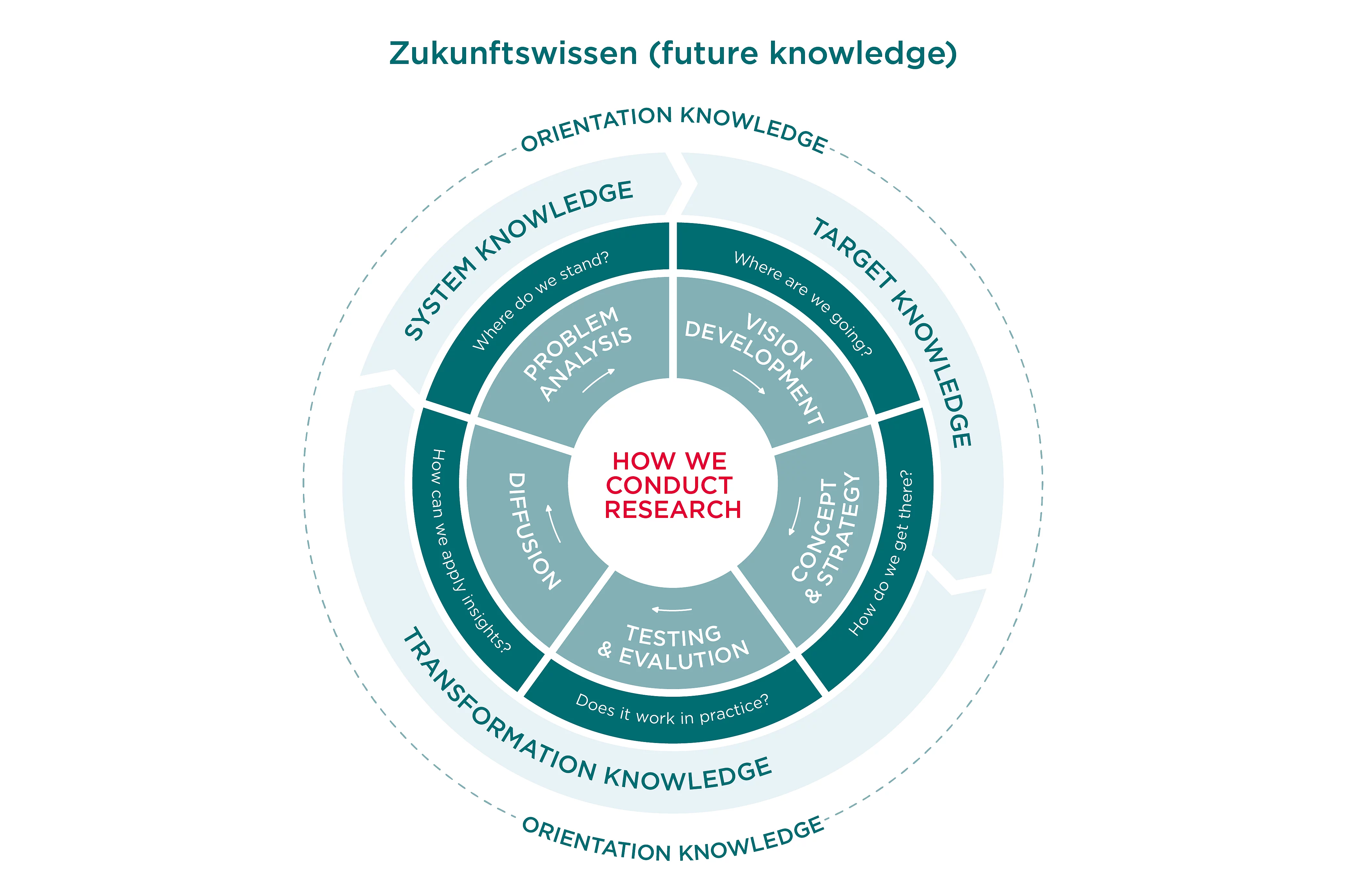
At the Wuppertal Institute, system knowledge means understanding the current structure of systems under examination (such as the energy system, or the city as a system) and how they function (i.e. status quo analysis). Researchers shed light on relevant framework conditions, complex interdependencies (i.e. socio-technical interactions) and decision-making processes within the system.
Building on this, researchers develop target knowledge by determining and discussing central targets of transformation processes. As this usually produces a variety of different targets, researchers identify conflicts and potential synergies, highlight potential problem areas, and develop visions, transformation pathways, concepts and strategies for achieving the targets.
Transformation knowledge is generated when scientifically supported concepts are tested in practice. The lessons from these practical experiences show how individual ideas can become realisable solutions for many people and how to scale them.
System knowledge, target knowledge and transformation knowledge form the basis for practical orientation knowledge. When combined effectively, these forms of knowledge provide decision-makers with clarity on pertinent targets, open up strategic options and convey an understanding of implementation methods. Orientation knowledge helps to prevent stakeholders losing sight of the big picture, even in complex systems, and enables them to take effective, targeted action in uncertain and dynamic situations.
Scientific self-concept
In our research, we connect scientific integrity directly with societal impact. The Wuppertal Institute’s research is guided by four principles that are consistently refined through continuous reflection and learning processes. These principles ensure that our research is societally relevant and meets the highest standards of scientific quality:
- Integrity and transparency: Scientific integrity is fundamental to research. The Wuppertal Institute is committed to honest, rigorous work in line with the principles of Good Scientific Practice. Drawing on state-of-the-art methods, researchers pursue an open-ended, accessible and transparent approach through systematic adherence to the highest scientific and ethical standards.
- Implementation and impact: Researchers concentrate on implementation and practice-oriented relevance for the transition – in line with the Institute's Mission Statement – in order to achieve direct societal impact.
- Interdisciplinary and transdisciplinarity: In its research, the Institute routinely connects different disciplines from the natural sciences, humanities, design sciences and social sciences. Its researchers develop questions and test concepts through active collaboration with stakeholders in the worlds of politics, business and wider society. This results in practically relevant, directly implementable and scientifically sound solutions.
- Communication and transfer: The Institute's staff make the resulting insights comprehensible and suitable for different target audiences.
Projects
Here you find selected sample projects with a transformative research approach.