
Topics
ShapingHealthyLiving Spaces
Every facet of our lives has an impact on our health, from where we live, learn and work to the places we frequent in our leisure time. Research by the Wuppertal Institute examines how to shape living spaces and provisioning systems that promote health – while advancing equal opportunities, climate protection and resource conservation.
Climate change, environmental pollution, resource consumption, biodiversity loss and social inequality are transforming the fundamental conditions of our existence and presenting new challenges for healthcare systems. These issues affect urban districts, businesses and wider society in equal measure.
Anyone seeking to protect human health also needs to protect the planet. The concepts of Planetary Health – which aims to achieve universal health of people and planet – and One Health emphasise this key link. A holistic understanding of sustainability regards the health of people and planet as closely intertwined, making it impossible to consider one in isolation from the other. With this in mind, sustainable development means shaping living spaces in such a way that they promote health, protect the climate and the environment, and can be implemented in a socially just manner. These objectives are inextricably linked: none can be achieved without the others.
The Wuppertal Institute's research therefore examines how key areas – such as food, mobility, housing, leisure time, arts and culture, and clothing – can be made more sustainable and promote health. At the core of this work are integrated solutions that connect multiple benefits, such as liveable neighbourhoods and cities adapted to cope with the impacts of climate change through the targeted expansion of blue-green infrastructure. However, the Institute also analyses issues including the environmental interdependencies associated with developments in the fields of health technology, pharmaceuticals and medical engineering. Working in partnership with stakeholders from the world of politics, public administration and business along with people on the ground, our researchers develop solutions to promote a healthy everyday world that protects the climate – without leaving anyone behind.
How research and practice are driving the sustainable transformation
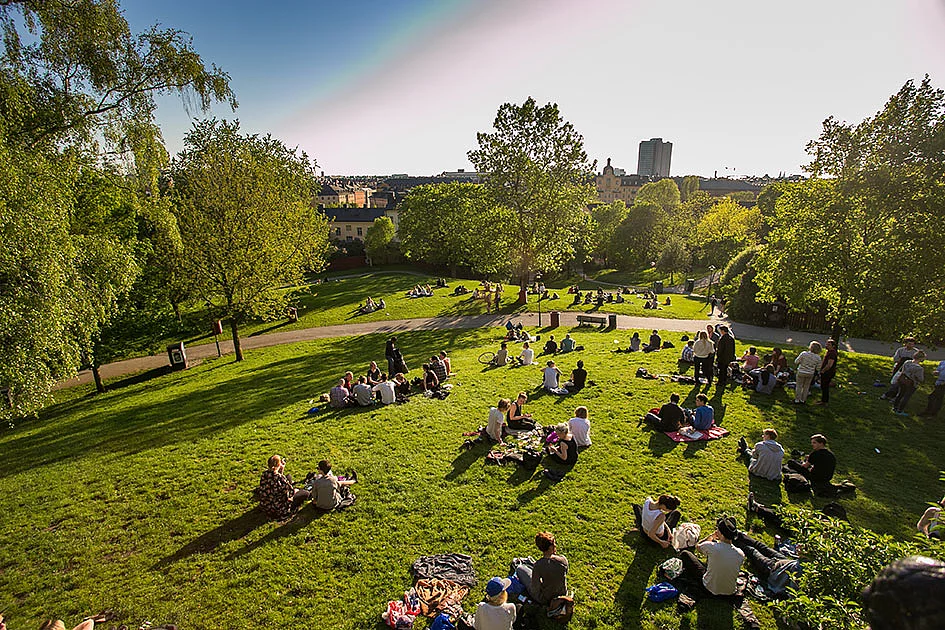
Integrated urban development – incorporating health in all policies – is a vital part of building a healthy, future-ready society. In this context, real-world labs geared towards innovation have an important role to play. When local and regional authorities consider climate protection, climate change adaptation and health promotion in unison, it can generate meaningful synergies. Green, shaded spaces, an increased emphasis on mobility (i.e. establishing attractive pedestrian routes and high-quality cycling infrastructure) and 15-minute cities protect the climate while simultaneously promoting the health of their people who live there. The Wuppertal Institute relies on transdisciplinary living labs to translate such concepts from theory to practice. This research format enables researchers and stakeholders in local administrations to collaborate in examining what healthy, climate-resilient and socially just living spaces might look like in practice.
The InnovationsCommunity Urban Health project focuses on creating healthy and equitable living conditions in cities and places a particular emphasis on to bridging the implementation gap between scientific findings and their practical application. Another pioneering project, T hoch 3, looks at the nexus of tradition, participation and transformation by viewing allotment gardens as inclusive, social spaces that promote health, foster participation and improve heat resilience. Advanced together with BARMER, the URBAN SusHealth project examines strategies that systematically link health promotion, prevention, climate change adaptation and equal health-related opportunities. The Future in Motion project, conducted in partnership with AOK Rheinland/Hamburg, focuses on creating incentives for children to exercise and make sustainable day-to-day mobility choices. The SalusTransform project investigates how urban development can unite the issues of health, social justice and climate protection. It aims to derive concrete approaches for sustainable, health-promoting municipal administration. In the Identification of Social-Ecological Problems as a Basis for Integrated Strategies for Sustainable and Healthy Cities and Neighborhoods of Tomorrow project, researchers produced an index: a set of indicators that municipal authorities can deploy to identify local socio-ecological problems and, in turn, effectively develop and prioritise measures for healthy and sustainable urban development. The successor project aims to refine the index to provide a highly practical support system for local authorities. In addition, the WISIONS Transitions project – advanced together with partners in Nepal and Nigeria – seeks to identify adaptations to strengthen and improve the resilience of livelihoods in regions particularly affected by climate change.
The healthcare system itself, along with its associated stakeholders, also has a decisive role to play. By prioritising well-being and prevention over reactive treatment, health insurance providers are increasingly demonstrating a commitment to a just and climate-resilient society. Working in collaboration with local authorities and other partners, researchers target solutions with dual benefits for people and planet. These include initiatives to support sustainable food production, active mobility, climate-aware health literacy and sustainable structures in neighbourhood development and provisioning systems.
Resource-conserving provisioning systems and systematic impact measurement
A sustainable transformation will require a fundamental restructuring of provisioning systems to prioritise resource conservation – from food and housing to mobility and healthcare provision. In collaboration with companies including BARMER and AOK as well as hospitals, the Institute's researchers investigate issues including product and service design methods with the potential to cut resource consumption while boosting health and well-being. For instance, sustainably structured plant-based canteens demonstrate how resource conservation and health promotion can go hand-in-hand.
In the EBEM-KAT project, the Wuppertal Institute and the University Hospital of Düsseldorf (UKD) are systematically recording climate-relevant emissions in ophthalmology – with the aim of achieving long-term reductions and establishing sustainable structures in everyday clinical practice. In addition, the Wuppertal Institute partnered with the North Rhine-Westphalia Hospital Association (KGNW) to develop Target Vision: Climate-Neutral Hospital, which includes implementation-oriented advice to help hospitals implement climate change adaptation, climate protection and resource efficiency measures. The Circular.Care.Solingen project is exploring means of establishing of circular economy models in the healthcare sector through sustainable procurement, enhanced waste management and scientifically guided pilot projects. Another example is mobility concepts for companies and municipalities to facilitate the modal switch to cycling and walking, thereby reducing emissions while improving physical fitness. This combines the Planetary Health concept (i.e. universal health of people and the planet) with biodiversity and sustainable urban development in a single, systematic research approach.
For measures like these to succeed over the long term, it must be possible to both measure and control their impacts. With this in mind, impact potential analyses form a central methodological component of the Institute's work. This approach facilitates structured recording and analysis of the complex dynamics of health, social and ecological effects, along with their interdependencies. It creates a robust tool for decision-makers, enabling them to seize on synergies in a targeted manner, identify conflicting objectives at an early stage and set a well-founded direction for integrated development, including at the municipal or neighbourhood level.

Our future health lies in the integrated design of climate-resilient, socially just living spaces. By embedding the principle of Planetary Health in local authorities, the world of business and provisioning systems, we are turning environmental and social challenges into sustainable transformation processes.
Topics
Research foci in the field of health are:
News
Here you find up-to-date information on research findings and activities in the field of health.
News on the topic
Publi-cations
You find all scientific publications on our publication server:
Projects
Research in the field of health takes place in an inter- and transdisciplinary context. In the following you find selected sample projects. A complete list is available here.