
Topics
Education in anAge of Upheaval
In times dominated by crises, simply passing on knowledge is no longer enough. Instead, education should equip people with the skills they need to handle uncertainty, understand complex relationships and jointly develop robust solutions.
Resource scarcity, climate change, digitalisation, artificial intelligence (AI), demographic change and rising geopolitical tensions are all fundamentally changing society, the economy and the working environments. If we are to successfully shape societies and economic models to be more resilient and just, we must develop new skills and build a common foundation. The Wuppertal Institute's researchers therefore examine the skills that people, organisations and entire societies will need to actively shape the future and retaining their capacity to act, even in uncertain situations.
Now more than ever, there is an urgent need for systems and spaces that facilitate education for sustainable development (ESD) in every phase of life, enabling people to discover and engage with insights on wide-ranging topics – from environmental conservation and climate protection to active design in the built environment through to testing and implementation of measures. Pairing this form of experiential learning, which is based on action and self-efficacy, with formal and informal knowledge transfer methods necessitates a fundamental shift in existing teaching and learning structures. This will require wide-ranging skills so that individuals can find expression in social contexts and develop organisational, implementation-oriented and subject-specific competencies.
Developing future skills
But what should education look like in a world marked by upheaval? Striving to find answers to precisely this question, Wuppertal Institute researchers examine how organisations and communities can develop future skills, placing particular emphasis on the design of modern learning spaces. Our researchers demonstrate how synergies between science, business, politics and civil society can foster vibrant innovation networks, opening the door to a sustainable future. Ultimately, of course, the future is not a state or condition – it is a creative challenge.
The Wuppertal Institute's researchers combine ESD with future literacy, design approaches, innovation research and transdisciplinary research. Future literacy is the ability to identify different potential futures, reflect on them critically and work responsibly to help shape them. It includes systems thinking, creativity, design skills, collaboration, reflective and innovative capacity, as well as a responsible approach to uncertainty and new technologies.
In this context, learning is perceived as a shared innovation process. With this in mind, the Wuppertal Institute researches and develops learning and innovation ecosystems, in which the stakeholders from science, business, politics and civil society together explore new forms of learning, experimentation and collaboration. Real-world labs, living labs, design and innovation labs, experimentation spaces, learning spaces and AI-assisted learning environments represent key spaces for research and development.
Research methods, didactics and qualifications
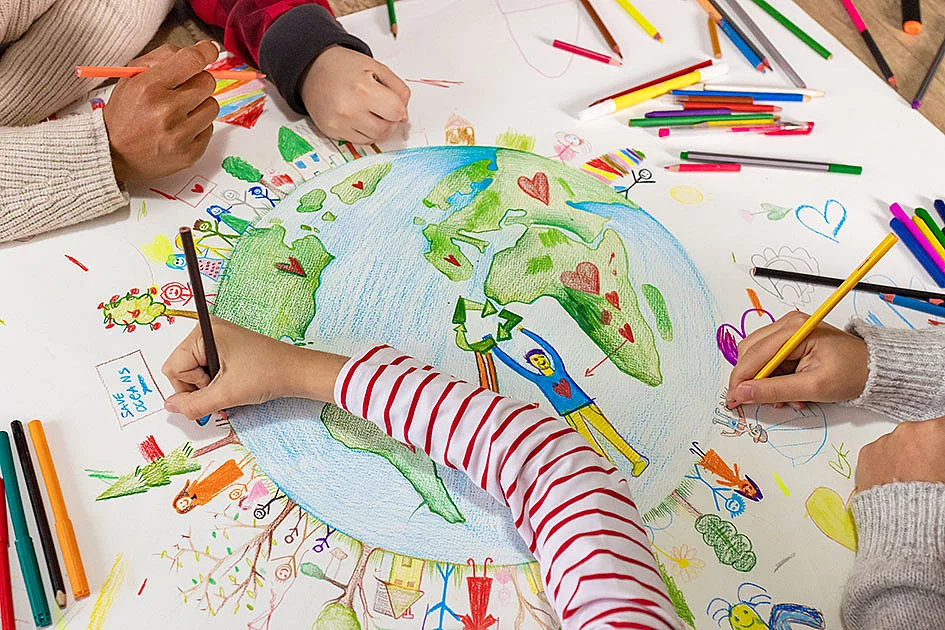
Developing evidence-based methods for learning, innovation and shaping the future is one focus of our research. Together with our partners, our researchers develop and evaluate didactic approaches, training formats, teaching and learning modules, and practical tools for various target audiences.
These include the Open Didactic Exploration (ODE) method developed by the Wuppertal Institute, the Transition Design Guide, co-creation methods such as Design for Social Change, creative workshops and open learning spaces for real-world labs, businesses and educational institutions. Our approaches support skills development, organisational learning and innovation for people at every stage in life – because the transformation affects everyone. Consequently, our research covers all stages of education:
- Early childhood education
- Primary and secondary school
- College and university
- Vocational school
- Vocational training in companies (from SMEs to skilled trades to large enterprises)
- Extracurricular places/forms of learning
Focus topics include the circular economy, resource conservation and resource efficiency; renewable energy and energy efficiency; sustainable product-service systems; climate protection and climate change adaptation; health; mobility; housing and construction; food; and sustainable business.
Networking: Shaping the future – together
The Wuppertal Institute is increasingly engaged in research in the context of education projects throughout Europe. Humboldtn – the sustainability network of universities in North-Rhine-Westphalia, founded by the State Rectors' Conference – is one of the Wuppertal Institute's key cooperation partners. We also enjoy close collaboration with an ESD-focused teacher training network: BNE Netzwerk in der Lehrkräftebildung. The primary aim is to give prospective teachers the essential skills for education for sustainable development, enabling them to pass on their knowledge to subsequent generations and prepare them for the future.
In the course of this collaboration to date, we conducted a complete survey on the topic of sustainable development at universities in North Rhine-Westphalia during the 2024 summer semester. A similar study is underway at universities of applied science in 2026. This work is supported by topic leads on the Board of Education for Sustainable Development at Zukunftskonferenz.NRW – the first collaboration between two associations for sustainability in higher education in North-Rhine Westphalia. Humboldtn brings together universities, while NAW.NRW is an alliance of universities of applied science. By joining forces and collaborating with extra-university research facilities, the associations hope to help accelerate the implementation of North-Rhine Westphalia’s Sustainability Strategy.
Topics
Research foci in the field of education are:
News
Here you find up-to-date information on research findings and publications in the field of education.
News on the topic

Rethinking Sustainability – Principles and Practice
Open access book published by Springer Nature, featuring a chapter on a sufficiency-oriented circular economy by Kathleen Jacobs

Digital GreenTalents Award 2026: Focus on Sustainability and Digitalisation
Henning Wilts on the jury of the Digital GreenTalents Award 2026 for young international scientists
Improving Education-Driven Solutions for Youth in Climate Action
Workshop: strengthening young people for climate protection and energy transition
Publi-cations
You find all scientific publications on our publication server:
Projects
Research in the field of education takes place in an inter- and transdisciplinary context. In the following you find selected sample projects. A complete list is available here.